
By John Wokersien
Pick yourself one of those bracing winter’s days when you wake up to a glistening frost and the sky is sapphire blue. Chose a time about 2 hours after high tide and head on down to Orcombe Point, Exmouth. Car parking a plenty at the end of the Esplanade with the usual pay and display charge but at winter levels. Bring your binoculars and camera, perhaps a thermos and a bite to eat. This is about a 3 mile round trip, easy walking with some gradient involved. Aim to take your time to take in the views and wildlife and wear good grip shoes.
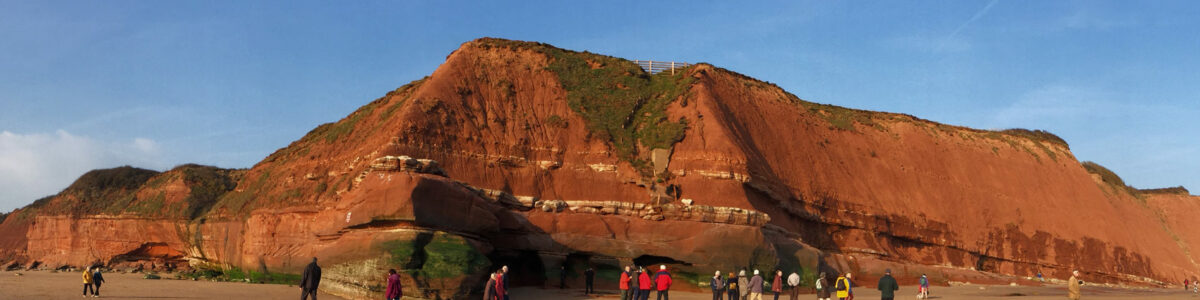
Orcombe Point is the start of the Jurassic Coast. The Triassic period of earth history is represented here although some say the rocks are actually Permian, so even older still. Just look at them and think 252 million years ago. Add another 50million years if Permian. You can’t but feel in awe right at the start of this walk if you let your mind break free from the present and all its noise. Those red rocks that face you as you start your walk are lined with what look like digger scratches as though a JCB has been at work. No – these are not the work of humans but the traces of when these rocks were laid down in a hot, arid desert much nearer to the equator than our coast is currently. Looking at the present Namib Desert gives us an idea of what the landscape would have looked like with great marching sand dunes across huge swathes of sun scorched ground. Those sand dunes bear their marks in the cliff face from all these years ago, trodden only by reptiles and insects before dinosaurs were even a twinkle in evolution’s eye.
Walk around the headland and the view is transformed with high red cliffs contrasting with the gentle Exe Estuary scenery and the bustle of Exmouth sea front. Here you see isolated pillars of rock remnants of the receding cliffs and wave cut platforms shining luminescent green with seaweed and algea contrasting vividly with the red rocks. The actions of the sea have carved out shallow caves with thousands of tons of rock held miraculously above them with a natural pillar here and there bravely holding the weight above them.
After heavy rain, hanging streams gush from v shaped valleys above, spraying into millions of tiny drops creating mini rainbows as they pour onto the rock platform below with an urgent hissing sound.
Observe the faults which can be seen in the cliff face is as you continue your walk where great lines of mudstone rock just stop but cast your eyes down to see where the lines starts again. Just imagine the seismic events which caused these great disturbances in the land, now revealed for all to see in the cross section of deep time displayed in these cliffs.
Always keep your eyes open as you walk and listen hard. Look seaward for gannets flying out at sea and maybe, just maybe you will see them fishing by plunge diving in their own spectacular way. Listen for the piping of Oyster Catchers and see their bright red bills and pied plumage. Grey Plovers may be seen working the water’s edge running in and out as the foamy water’s edge slides up and down the sand. Little rafts of Brent Geese sometimes venture out from the estuary, floating offshore. Be lucky and you might see eider ducks, mergansers maybe even Divers and Terns, or gliding on stiff wings along the cliff updraft a passing fulmar. Keep your ears attuned for the call of a Peregrine and look up to see its anchor shape gliding above. Look for white streaks of bird poop on the cliffs above. There you may be lucky to see a mighty Peregrine sitting high on a rock or small outcrop, preening nonchalantly, not yet hungry enough to bother to fly off and perform its mighty death stoop blow on some unsuspecting pigeon flying below.
Half-way down towards one of Europe’s largest holiday parks – Bourne Leisure’s Devon Cliffs often called Sandy Bay – you will find rock falls where great blocks of rock have fallen out of the cliff face. These rocks are lines of mudstone formed in bands during wetter periods when muddy clays were laid down. As the softer sandstone erodes these bands of rock tend to protrude until eventually the weight is too great and they fracture and fall in a tumbled mass of natural rock armour blocks at the foot of the cliff. Look out for Rock Pipets busying themselves as they seek out tasty morsels to stave off the chill.
Once you get to the end of Sandy Bay look out towards the rocky promontory of Straight Point. The cliffs which are too far out for the tide to expose beach have white marks all along them. This is the summer nesting ground for what is thought to be the UK’s southern-most colony of Kittiwakes. In the summer this is a hive of activity with the noisy Kitt ee Wake call filling the air. Look further along towards the point and standing sentinel with wings outstretched you can often see Cormorants and Shags just chilling before their next expedition, shooting the breeze and then transforming into submarines where the next fish supper is waiting.
Climb the ramp to Sandy Bay and then double back and start the gradual climb over the top of the cliffs. Once you leave the holiday park with its mobile homes and holiday chalets and often the rattling of machine gun fire from HM Royal Marines firing range, you will feel the breeze of the cliff tops amid dairy farm fields and shrubs of blackthorn, hawthorn, wild rose, blackberry. Summer haunts of butterflies, beetles and insects. A scene shaped absolutely by the geology beneath. At the highest
point look back and see the whole sweep of Lyme Bay. The chalk cliffs at Seaton clearly visible, Golden Cap, the yellow cliffs of Burton Bradstock, around to the island wedge of Portland.
A vast breath-taking sweep eastwards taking in 180 million years of earth history all in one view. To the west the bay curves round to Berry Head holding Torbay safely in its arms protected from westerly gales and creating a sub-tropical climate of its own. Soon the incline slopes downward with National Trust fields on the right of the path which in late May and early June are abloom with Green Winged Orchids. They appear in profusion, have their day, then all are gone without a trace – and so it is each year.
The Geoneedle marks the beginning of the World Heritage Site from its most westerly point. A point of interest with information boards telling its story and what it signifies. Look over the edge – careful now – and the local beach Banksy may have created amazing geometric sand drawings. Huge spirograph creations created with myriad circles using only a string and a garden rake.
Whilst on your walk you will not have found any fossils but you will have seen most of the Jurassic Coast in one sweep, felt the fresh sea air on your face, wondered at the deep time exposed in these most beautiful cliff faces and felt a sense of the primordial and a sense of freedom from the fuss and fluster of our modern times.